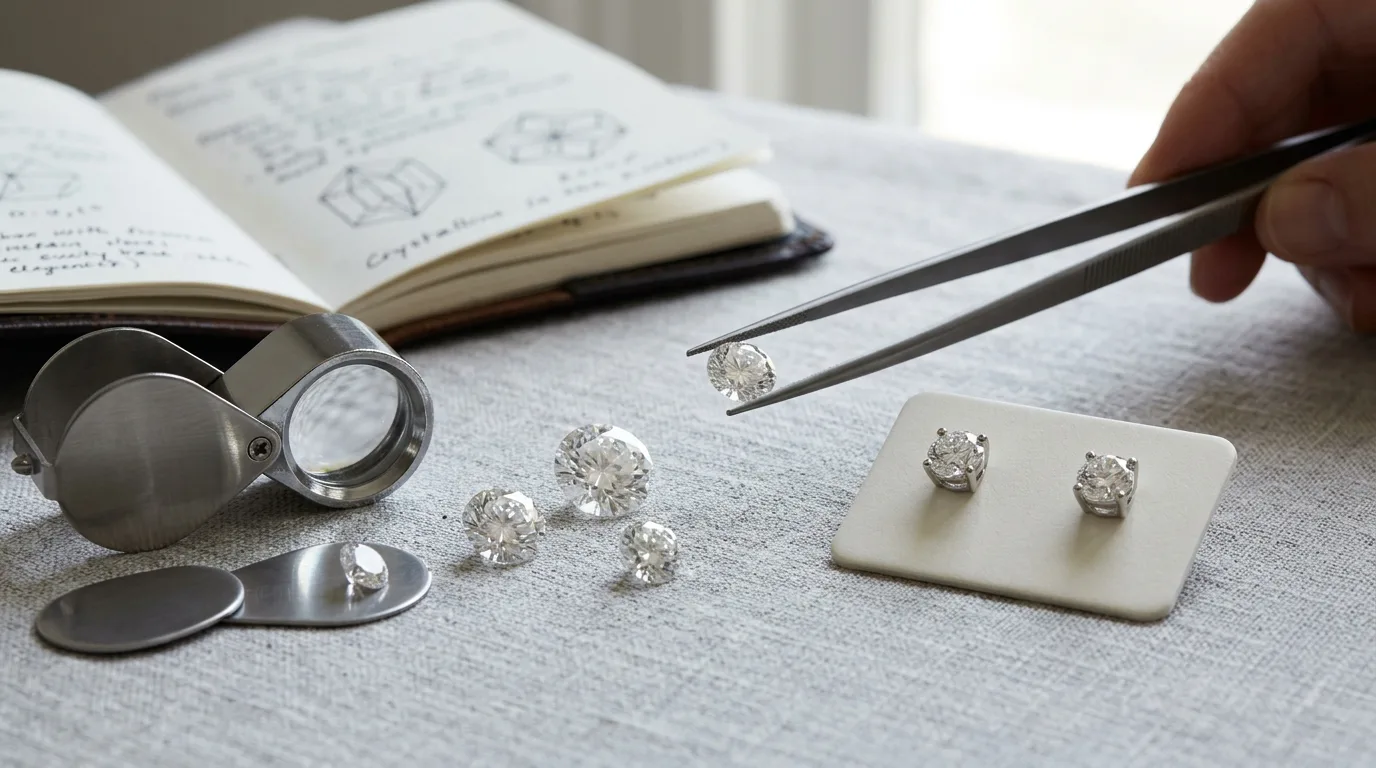
If you've been shopping for lab grown diamond earrings, you've probably noticed that pricing is kind of a mess. One pair runs $200, another $2,000, and both claim to be "real diamonds." It's genuinely confusing, and it's not just marketing fluff causing the problem.
Lab grown diamonds are chemically identical to mined diamonds. Same carbon crystal structure, same sparkle, same hardness on the Mohs scale. But the market hasn't fully matured yet, so you get wildly different pricing, inconsistent quality standards, and completely different value propositions depending on where you're shopping. Some retailers slap luxury markups on lab diamonds like they're selling mined stones. Others price them closer to what they actually cost to produce, which is a fraction of what you'd pay for an equivalent mined diamond.
Here's what actually matters: the 4Cs still apply (cut, clarity, color, carat), but you're also navigating grading inconsistencies between labs, almost nonexistent resale value, and a whole lot of retailers banking on the assumption that you can't tell a well-cut stone from a mediocre one. By the time you finish reading this, you'll know what drives the price, what to actually compare before buying, and which details make a visible difference when you look in the mirror.
Fast Answer
Lab grown diamond earrings typically cost 40-70% less than mined diamond equivalents, but the price swings based on carat weight, cut quality, clarity grade, metal type, and how much the retailer marks them up. A pair of 1-carat total weight studs in 14k white gold might run $400-$1,200. Bump that to 2-carat total weight and you're looking at $1,200-$3,500. The cheapest options usually mean compromises on clarity or cut. The priciest might reflect better craftsmanship, or just a fatter brand margin.
Why This Gets More Complicated Than "They're Just Cheaper Diamonds"
Lab diamonds aren't one monolithic product category. They're grown using two different methods (CVD and HPHT), graded by multiple organizations that don't always agree, and sold by everyone from legacy jewelers to scrappy direct-to-consumer startups.
I've personally seen identical-looking 1-carat studs priced $600 apart because one had an IGI cert and the other had a GIA cert, even though the grades were practically the same. The retailer carrying the GIA stone charged more because GIA has a reputation as the stricter grading lab. But if you're wearing these earrings and not flipping them on the secondary market, that premium might be completely irrelevant to you.
Then there's cut quality, which varies way more than most buyers expect. A poorly cut lab diamond looks dull and lifeless, even with flawless clarity. And because lab diamonds cost less to produce, some manufacturers skip the premium cutting process entirely. You end up with stones that are technically diamonds but lack the fire and brilliance you pictured when you started shopping.
What Actually Affects the Price
Carat Weight Pretty straightforward. Bigger stones cost more. But the price per carat climbs as size increases, so the jump isn't linear. A 0.5-carat total weight pair might cost $300. A 1-carat pair could be $800. Go to 2-carat total weight and you might hit $2,500.
Cut Quality This is the single most important factor for how earrings actually look on you. Excellent or Ideal cut stones bounce light around beautifully, which translates to real sparkle. Good or Fair cuts? They look flat. Lifeless. Some retailers don't even bother listing cut grades, and that should raise an eyebrow. If you're comparing two pairs and one specifies "Ideal cut" while the other stays silent on the topic, assume the quiet one isn't ideal.
Clarity Grade Clarity measures internal flaws (inclusions) and surface blemishes. Here's the thing with earrings though: nobody is pulling out a loupe to inspect your ears at dinner. VS2 or SI1 clarity is typically eye-clean in stones under 1 carat, meaning you won't see any flaws without magnification. Springing for VVS1 or VVS2 is overkill unless you personally want that level of perfection.
Color Grade Color runs from D (completely colorless) to Z (noticeably yellow or brown). If you're setting stones in white gold or platinum, stick with at least G or H to avoid any visible tint. Yellow gold is more forgiving. You can drop to I or J because the warmth of the metal masks warmth in the stone. Lab diamonds also come in fancy colors like blue, pink, and yellow, which get priced based on intensity and how tricky that particular shade is to produce.
Metal Type You'll find settings in 10k gold, 14k gold, 18k gold, platinum, and silver. For diamond studs, 14k white gold is the sweet spot for most people. Platinum costs more because it's denser and more durable, but the practical difference in earrings isn't as big a deal as it is in rings. If budget matters, 14k gold gets you the look without the price premium.
Certification GIA and IGI are the two grading labs worth paying attention to. GIA grades more strictly and has a longer track record, so GIA-certified stones tend to cost a bit more. IGI is widely used for lab diamonds and is generally reliable. But some retailers use obscure labs with looser grading standards. If a pair of earrings doesn't come with a cert from a recognized lab, treat that as a yellow flag unless the price already accounts for it.
Retailer Markup This is where you see the biggest price gaps for otherwise similar stones. A traditional jeweler might mark up lab diamonds 2-3x because their whole brand identity is built around luxury positioning. A direct-to-consumer company might price close to production cost plus a reasonable margin. Same stone, totally different business model.
What to Compare Before Buying
| Factor | Why It Matters |
|---|---|
| Total carat weight vs. per-earring weight | Some retailers list total carat weight (both earrings combined), others list per-earring. Confirm which one you're looking at. |
| Cut grade listed? | If it's missing, assume average or below. You want "Ideal" or "Excellent." |
| Clarity grade for the price | VS2 is plenty for studs under 1 carat. Don't overpay for VVS unless it's something you genuinely want. |
| Certification lab | GIA or IGI preferred. Unknown labs may grade generously. |
| Return policy and warranty | Lab diamonds are tough, but settings fail. Look for at least a 30-day return window and some form of warranty on the metalwork. |
| Matching stones | Earrings need to be closely matched in color and clarity. Ask specifically if they're a matched pair or just "similar." |
| Setting quality | Screw backs hold more securely than push backs. Check that prongs look substantial in photos or descriptions. |
Common Mistakes People Make
Assuming All Lab Diamonds Look the Same They really don't. A poorly cut 1-carat lab diamond will look worse than a well-cut 0.75-carat stone. If you want sparkle, cut quality beats size every time.
Overspending on Clarity For earrings, you almost never need anything above VS2 clarity unless you're buying really large stones (think 2+ carats per earring). The inclusions in an SI1 stone are virtually invisible when the diamond is sitting on your earlobe.
Ignoring the Setting Flimsy prongs or cheap posts lead to lost earrings. It happens more than people think. Make sure the setting is well-made, especially if you're ordering online from a brand you haven't dealt with before.
Not Checking if Stones Are Matched One earring that's slightly yellower or cloudier than the other? It looks wrong. Good sellers match their pairs carefully. Budget sellers sometimes just grab two stones that are close enough.
Buying Based Only on Price Per Carat A $300-per-carat stone with a Fair cut is a worse deal than a $400-per-carat stone with an Ideal cut. Price per carat tells you nothing about how the diamond actually performs.
Expecting Resale Value Like Mined Diamonds Lab diamonds don't hold value the way mined diamonds do. And honestly? Mined diamonds don't hold value nearly as well as people have been led to believe either. If you're buying earrings as an investment vehicle, you're in the wrong aisle. If you're buying them to wear and enjoy, resale value is beside the point.
Questions to Ask Before You Buy
- What's the cut grade, and does it appear on the certificate?
- Are the stones certified? By which lab?
- What's the total carat weight, and how is it divided between the two earrings?
- Are the two diamonds actually matched for color and clarity?
- What metal is the setting, and what's the purity (10k, 14k, 18k)?
- What type of backing does it use (screw back, push back, latch back)?
- What's your return policy if the stones don't match the cert or look different in person?
- Is there a warranty on the setting, and does it cover a stone falling out?
FAQ
Are lab grown diamonds real diamonds? Yes. Same chemical composition, same crystal structure, same optical properties as mined diamonds. A jeweler can't distinguish them without specialized equipment designed specifically for that purpose.
Do lab grown diamond earrings look different from mined diamonds? Not to your eye. The only way to tell is with a lab instrument that picks up on growth patterns unique to the manufacturing process. Visually, if the quality matches, they're indistinguishable.
How much should I expect to pay for 1-carat lab diamond studs? For well-cut stones in the VS2-SI1 clarity range with G-H color, budget $600-$1,200 in a 14k gold setting. Better clarity or superior cuts push the price higher. Cheaper options exist, but scrutinize the specs before you commit.
Can I get lab grown diamonds in other earring styles besides studs? Absolutely. Hoops, drops, dangles, clusters. Studs are just the most popular because they put the diamond front and center.
Will lab grown diamond earrings hold their value? Not meaningfully. Lab diamonds are relatively inexpensive to produce, so the resale market is soft. Mined diamonds, for what it's worth, also depreciate more than the industry likes to advertise. Buy these to wear and love, not to store value.
What's the difference between CVD and HPHT lab diamonds? CVD (Chemical Vapor Deposition) and HPHT (High Pressure High Temperature) are two manufacturing processes. Both produce genuine diamonds. CVD stones can sometimes have slightly different inclusion types or faint color characteristics, but once a stone is cut and set in jewelry, the distinction is academic for most buyers.
Final Thoughts
Lab grown diamond earrings make a lot of sense if you want real diamonds without paying the mined diamond premium. But you still have to know what you're looking at. The quality spectrum is wide, pricing is all over the map, and plenty of retailers are counting on you not to ask about cut grades or certifications.
Prioritize cut quality above everything else. Then dial in clarity and color based on your setting choice and what you're comfortable spending. Make sure the stones are certified by a reputable lab and properly matched as a pair. And if a price looks suspiciously low, look at what's missing from the listing. Nine times out of ten, it's the cut grade, the cert, or both.
The real upside of lab diamonds is simple: you can own a genuinely beautiful pair of earrings without the ethical baggage of mining and without paying for artificially inflated scarcity. Just do your homework so you actually know what you're getting for your money.