
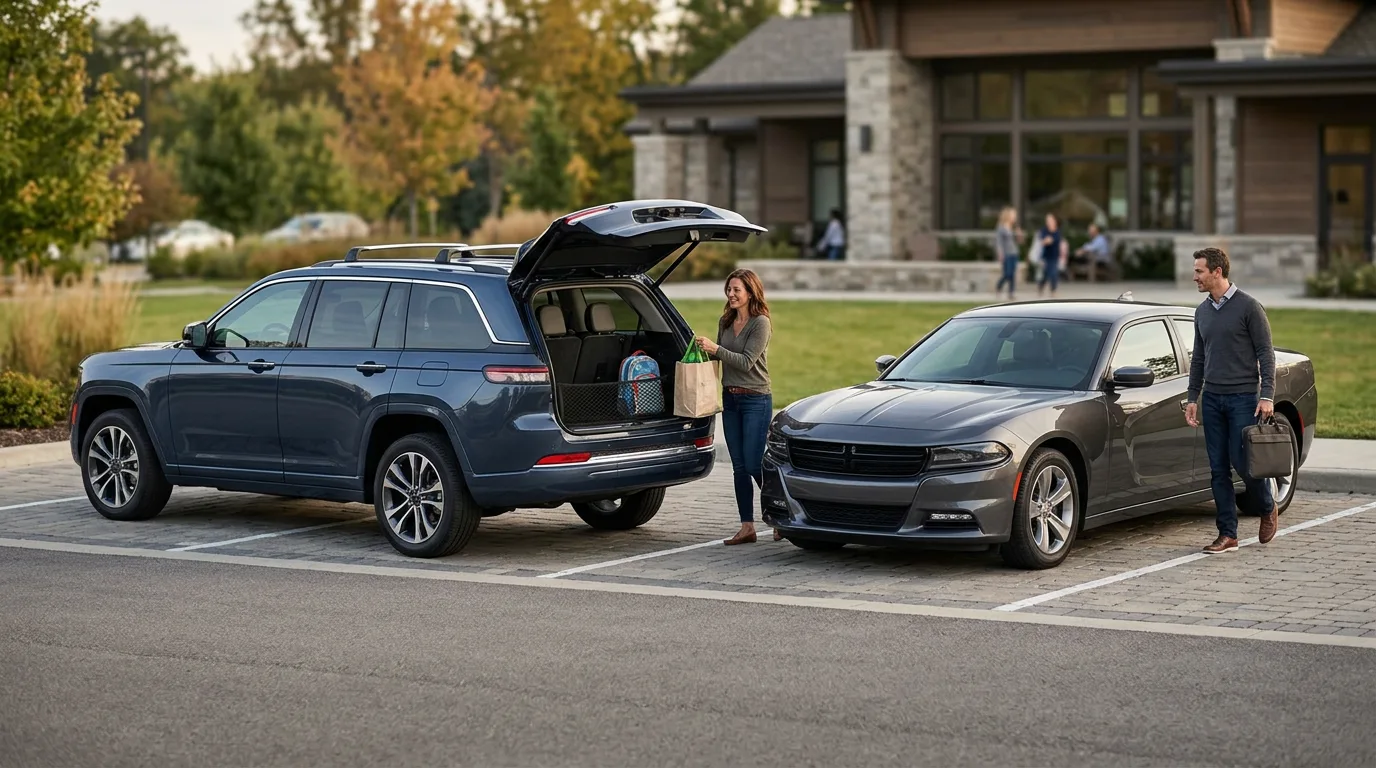
When you compare a Jeep (especially a larger model like the Grand Cherokee L or Wagoneer) to a full-size sedan or crossover, you're not just weighing two vehicles. You're comparing two different philosophies: ground clearance, seating capacity, towing, and off-road capability versus fuel economy, handling, and daily drivability. Neither category is universally better. The right choice depends on how you drive, where you live, what you haul, and what trade-offs you're willing to accept.
Most buyers assume the decision is simple: "Do I need space?" But the reality is more nuanced. A three-row SUV like the Wagoneer offers seating and cargo flexibility, but it costs more upfront, uses more fuel, and handles differently than a midsize sedan. A car like the Honda Accord or Toyota Camry delivers better gas mileage and easier parking, but it can't tow a trailer or navigate unpaved roads. And crossovers like the Honda Pilot or Hyundai Palisade sit somewhere in between.
This article explains the core differences, compares real-world factors side by side, and helps you identify which category aligns with your actual priorities before you test drive or compare specific models.
Fast Answer
A Jeep (or comparable three-row SUV like the Wagoneer, Chevy Tahoe, or Ford Expedition) offers more seating, towing capacity, and off-road capability than a full-size sedan or midsize crossover. However, it costs more to buy, insure, and fuel. A sedan like the Honda Accord or Toyota Camry delivers better fuel economy, easier maneuverability, and lower ownership costs, but it lacks cargo space, towing ability, and ground clearance.
The right choice depends on:
- Whether you regularly need a third row or towing capacity
- Your typical driving environment (highway, city, unpaved roads)
- Your budget for upfront cost, insurance, and fuel
- How often you haul passengers, gear, or trailers
- Whether you prioritize comfort, capability, or economy
Why This Decision Is More Complicated Than It Looks
Most buyers start by asking, "Do I need more space?" But the real question is: "What type of space, and at what cost?"
A Jeep Wagoneer or Grand Cherokee L can seat seven or eight people and tow up to 10,000 pounds. But it averages 16-19 mpg combined, costs $60,000-$90,000 new, and requires more expensive tires, brakes, and maintenance than a sedan. A Honda Accord seats five comfortably, gets 30+ mpg, and costs $30,000-$40,000 new, but it can't tow more than 1,000 pounds (if at all) and offers limited cargo space.
Crossovers like the Honda Pilot, Toyota Highlander, or Hyundai Palisade split the difference: they seat seven or eight, get 20-24 mpg, and cost $40,000-$55,000. They're easier to park than a Wagoneer but less capable off-road. They tow 5,000-6,000 pounds, enough for a boat or small camper, but not a large travel trailer.
The complication: your budget, lifestyle, and driving habits may not align neatly with one category. You might need third-row seating only twice a year. You might want towing capability but never use it. You might assume you need a big SUV because your family has grown, but a midsize crossover could handle 95% of your actual trips.
The Main Factors That Affect Whether You Should Choose an SUV or a Car
| Factor | Three-Row SUV (Wagoneer, Tahoe, Expedition) | Midsize Crossover (Pilot, Highlander, Palisade) | Full-Size Sedan (Accord, Camry, Charger) |
|---|---|---|---|
| Seating Capacity | 7-8 passengers, spacious third row | 7-8 passengers, tighter third row | 5 passengers, no third row |
| Towing Capacity | 8,000-10,000 lbs | 5,000-6,000 lbs | 1,000 lbs or none |
| Fuel Economy (combined) | 16-19 mpg | 20-24 mpg | 28-32 mpg |
| Starting Price (new) | $60,000-$90,000 | $40,000-$55,000 | $30,000-$50,000 |
| Cargo Space (behind third row) | 25-40 cubic feet | 15-20 cubic feet | 16-18 cubic feet (trunk) |
| Ground Clearance | 8-10 inches | 7-8 inches | 5-6 inches |
| Maneuverability / Parking | Challenging in tight spaces | Moderate | Easy |
| Off-Road Capability | High (4WD, low range, skid plates) | Moderate (AWD, decent clearance) | Low (front-wheel or RWD, low clearance) |
| Insurance Cost | Higher (expensive to repair, higher value) | Moderate | Lower |
| Typical Annual Maintenance | $1,200-$1,800 | $900-$1,400 | $700-$1,100 |
Key insight: If you rarely use the third row, don't tow, and drive mostly in the city or suburbs, a sedan or midsize crossover will cost you $5,000-$10,000 less per year in fuel, insurance, and depreciation. If you tow regularly, drive on unpaved roads, or frequently carry seven or eight people, a three-row SUV justifies the extra cost.
What to Compare Before Choosing a Category
Before you narrow down to specific models, compare these decision points:
1. How often do you actually need a third row? If you use it weekly (carpools, extended family trips, sports teams), a three-row SUV or crossover makes sense. If you need it twice a year, consider a sedan or midsize crossover with a fold-flat second row and rent a larger vehicle when necessary.
2. What do you tow, and how often? A jet ski or small utility trailer (under 3,000 lbs) works with a midsize crossover. A travel trailer, boat over 20 feet, or cargo trailer over 5,000 lbs requires a body-on-frame SUV like the Wagoneer, Tahoe, or Expedition. If you never tow, this capability is wasted expense.
3. What's your typical driving environment? City and highway: a sedan or crossover is easier to park, cheaper to fuel, and more comfortable in traffic. Unpaved roads, snow, dirt trails: a Jeep or comparable SUV with high ground clearance and 4WD handles better. Mixed: a crossover like the Honda Pilot or Subaru Ascent offers AWD and decent clearance without the bulk.
4. What's your annual mileage? If you drive 15,000+ miles per year, the fuel cost difference adds up. A sedan at 30 mpg costs roughly $2,000/year in fuel (at $3.50/gallon). A Wagoneer at 17 mpg costs $3,700/year. Over five years, that's $8,500 more in fuel alone.
5. What's your total budget (purchase, fuel, insurance, maintenance)? A $65,000 Wagoneer costs roughly $12,000-$15,000 per year to own (loan, fuel, insurance, maintenance, depreciation). A $35,000 Honda Accord costs $7,000-$9,000 per year. A $48,000 Honda Pilot costs $9,000-$11,000 per year. Factor in your realistic monthly budget.
6. Do you prioritize comfort, capability, or economy? Comfort: a luxury sedan (Genesis G80, Lexus ES) or premium crossover (Acura MDX, Lincoln Aviator) offers the smoothest ride and quietest cabin. Capability: a Jeep Wagoneer, Chevy Tahoe, or Ford Expedition offers the most towing, cargo, and off-road ability. Economy: a Honda Accord, Toyota Camry, or Mazda6 offers the lowest total cost of ownership.
Common Mistakes and Overlooked Details
1. Overestimating how often you'll use the third row Many buyers choose a three-row SUV for occasional use (holidays, road trips) and then pay higher fuel and insurance costs year-round. If you need the third row fewer than 20 times per year, a midsize crossover with a fold-flat second row and occasional rental may be cheaper.
2. Ignoring the true cost of ownership The purchase price is only part of the equation. A $65,000 Wagoneer costs $1,500-$2,000 more per year in insurance, $1,500-$2,000 more in fuel, and $300-$500 more in maintenance than a $40,000 Honda Pilot. Over five years, that's $16,000-$20,000 extra.
3. Assuming you need off-road capability you'll never use If you drive on pavement 99% of the time, the off-road features of a Jeep (low-range 4WD, skid plates, aggressive tires) add cost and complexity without practical benefit. A midsize crossover with AWD handles snow and gravel roads just fine.
4. Underestimating parking and maneuverability challenges A Jeep Wagoneer is 17 feet long and 7 feet wide. It's difficult to park in tight urban garages, navigate narrow driveways, or fit in compact spaces. If you live in a city or frequently park in crowded areas, this matters daily.
5. Focusing only on monthly payment, not total cost A longer loan term (72 or 84 months) makes a $65,000 SUV feel affordable, but you're paying more interest and depreciating faster. Compare the total five-year cost, including fuel, insurance, and maintenance, not just the monthly payment.
6. Not test-driving in real conditions Test a Wagoneer on your actual commute, with passengers, on the highway and in parking lots. Test a sedan on a gravel road or in bad weather. You'll quickly learn whether the category fits your real needs.
Questions Worth Asking Before You Decide
Use this checklist to clarify your priorities:
- How many passengers do I carry weekly? (5 or fewer = sedan or midsize crossover; 6+ regularly = three-row SUV)
- What's the heaviest thing I'll tow in the next five years? (Under 3,000 lbs = car or crossover; 5,000+ lbs = SUV)
- How many miles do I drive per year? (Under 10,000 = fuel cost matters less; over 15,000 = fuel economy matters more)
- What's my realistic monthly budget for loan, fuel, and insurance combined? (Add up all three for an honest total)
- Do I drive on unpaved roads, in deep snow, or off-road more than once a month? (Yes = SUV; no = car or crossover)
- Where do I park daily? (Tight urban garage = favor a sedan; driveway or spacious lot = SUV works fine)
- How long do I plan to keep this vehicle? (5+ years = total cost of ownership matters; 2-3 years = resale value and depreciation matter more)
- What do I actually haul or carry weekly? (Groceries, briefcase, gym bag = sedan is fine; camping gear, sports equipment, strollers = crossover or SUV)
Frequently Asked Questions
Is a Jeep Wagoneer more reliable than a Honda Pilot or Toyota Highlander? No. Honda and Toyota crossovers consistently rank higher in reliability surveys. The Wagoneer is newer to the market and uses more complex technology (air suspension, electronics, turbocharged engines), which historically leads to more repair issues. However, Jeep offers a strong warranty (5 years / 60,000 miles powertrain). If reliability is your top priority, a Honda Pilot or Toyota Highlander is a safer bet.
Can a midsize crossover tow a camper or boat? It depends on the weight. Most midsize crossovers (Honda Pilot, Toyota Highlander, Hyundai Palisade) can tow 5,000-6,000 pounds, which covers many pop-up campers, small travel trailers, and boats under 22 feet. A full-size SUV like the Wagoneer or Tahoe is necessary for trailers over 7,000 pounds. Check the specific towing capacity for your model and trailer weight before deciding.
Do I really need 4WD or AWD if I live in a snowy climate? AWD or 4WD helps you accelerate and maintain traction in snow, but it doesn't improve braking or turning. Good winter tires on a front-wheel-drive sedan often outperform AWD with all-season tires. If you live in a snowy area with steep hills or unpaved roads, AWD or 4WD is worth having. If you drive mostly on plowed roads, invest in winter tires instead.
How much does it cost to insure a Jeep Wagoneer versus a sedan? A Wagoneer typically costs $1,800-$2,500 per year to insure, depending on your age, location, and driving record. A Honda Accord or Toyota Camry costs $1,200-$1,600 per year. The difference comes from the higher purchase price, more expensive repairs, and increased liability exposure (larger vehicle, more damage potential). Get quotes for specific models before deciding.
Is a sedan still practical for a family with kids? Yes, if you have two or fewer children and don't frequently haul large gear. Modern sedans like the Honda Accord, Toyota Camry, and Subaru Legacy have spacious rear seats and large trunks (15-18 cubic feet). If you need more cargo space occasionally, roof racks or a hitch-mounted carrier add flexibility. The trade-off is lower cost, better fuel economy, and easier parking.
What's the resale value difference between a Jeep and a sedan? Jeep Wranglers and Grand Cherokees hold value well due to strong demand. The Wagoneer is too new to predict long-term resale. Honda and Toyota sedans and crossovers historically depreciate slower than most American SUVs. After five years, expect a Honda Accord or Toyota Camry to retain 50-55% of its value, a Honda Pilot or Toyota Highlander to retain 52-58%, and a Wagoneer to retain 45-50% (estimated based on similar models). Lower depreciation reduces your total cost of ownership.
Conclusion
Choosing between a Jeep (or comparable three-row SUV) and a sedan or midsize crossover comes down to how you actually drive, not how you imagine you might drive someday. If you regularly tow, carry seven or eight passengers, or navigate unpaved roads, the capability of a Wagoneer, Tahoe, or Expedition justifies the higher cost. If you drive mostly on pavement, rarely need more than five seats, and want to minimize fuel and ownership costs, a sedan like the Honda Accord or a crossover like the Honda Pilot will save you thousands per year without sacrificing practicality.
The best approach: calculate your total five-year cost (purchase price, fuel, insurance, maintenance), test drive in your real conditions, and honestly assess how often you'll use the extra capability. The right vehicle is the one that fits your actual needs 95% of the time, not the edge cases that happen twice a year.
Compare multiple models within each category, check current incentives and financing rates, and consult with your insurance provider for accurate cost estimates. The vehicle you choose will affect your budget, comfort, and daily routine for years to come, so take the time to evaluate carefully before deciding.